ABOUT
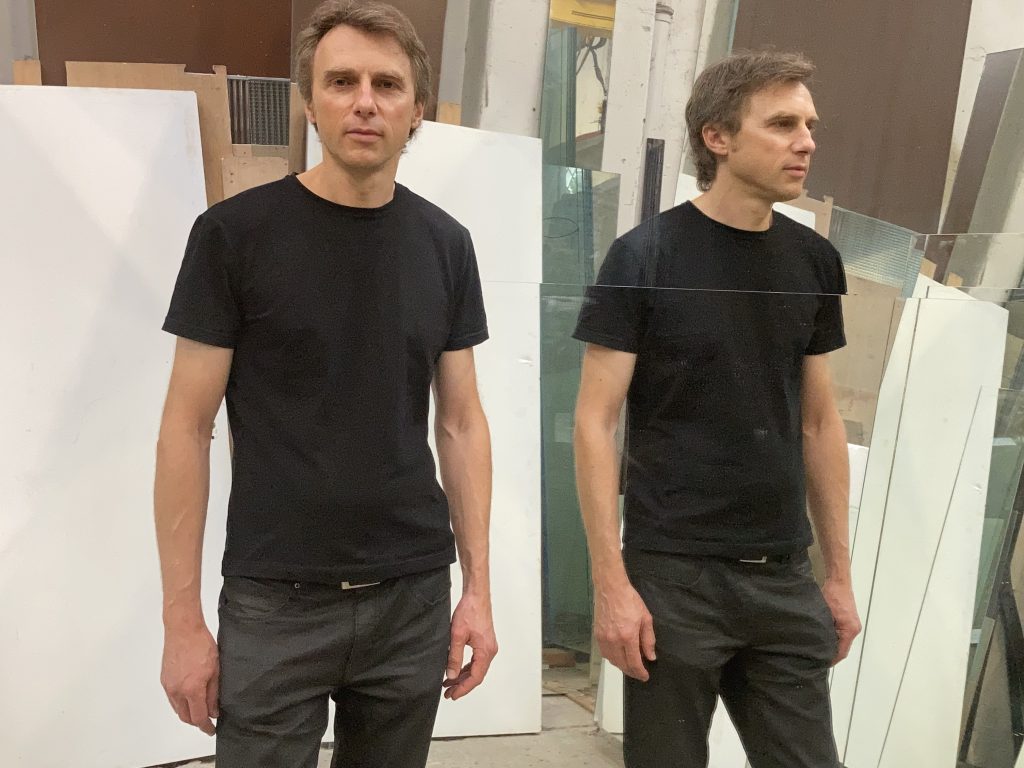
Mathieu Wolniewicz is a visual and perceptual artist living between Paris and the Costa Blanca. He develops a specular dispositif through a singular practice of mirror-paintings, in which his work is not represented as a fixed image, but activated by the presence of the viewer. The mirror is not a simple support, but a perceptual threshold where the image exists only through light, movement, and the engagement of the viewing body.
THE PROCESS
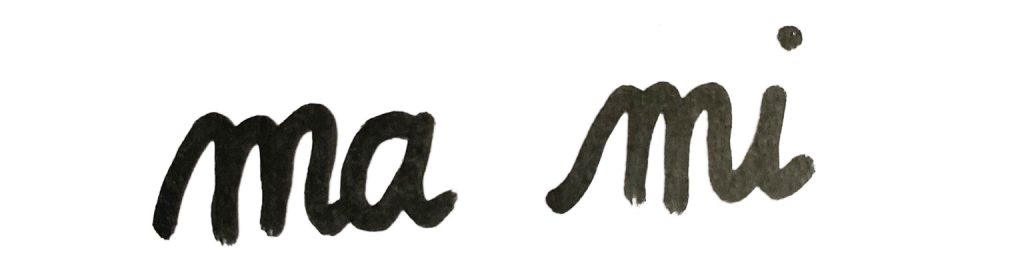
After several years of experimentation beginning in 1995, his work gradually came to focus on new, recycled and antique mirrors. He signs these mirror-paintings “ma mi,” a name inspired by magic mirror, evoking doubling and reflection.
PERCEPTUAL MECHANISM
He works directly by sculpting the surface of the glass, painting and engraving the mirror in order to construct a perceptual mechanism in which the viewer becomes an active participant in the work.
In daylight, the image fragments and doubles through the mirror’s internal reflections, creating an unstable and shifting perception.
The viewer is invited to enter into an intimate relationship with the work: their own reflection merges with the engraved and painted mirror, continuously altering the image according to their position and the intensity of the light.
As the light softens, the device can be activated by an artificial source, causing the image to be projected beyond the mirror itself. The work then transcends its frame and engages the surrounding space as a surface of manifestation.
Thus, his mirror-paintings function as activatable specular dispositifs, oscillating between sculpted materiality and immaterial appearance. Light becomes a vector of passage between the visible and the invisible, and the pictorial surface a meeting place between gaze and presence. These works invite the viewer to perceive the image not as an evident given, but as a fragile phenomenon in constant transformation.
Mathieu Wolniewicz est un artiste plasticien et perceptif vivant entre Paris et la Costa Blanca. Il développe un dispositif spéculaire à travers une pratique singulière de tableaux-miroirs, dans laquelle son travail n’est pas représenté comme une image fixe, mais activé par la présence du regardeur. Le miroir n’y est pas un simple support, mais un seuil perceptif où l’image n’existe qu’à travers la lumière, le mouvement et l’engagement du corps regardant.
LE PROCESS
Après plusieurs années d’expérimentations entamées en 1995, son travail s’est progressivement concentré sur des miroirs neufs, recyclés et anciens. Il signe ces tableaux-miroirs « ma mi », un nom inspiré de magic mirror, évoquant le double et le reflet.
MECANISME PERCEPTIF
Il travaille directement en sculptant la surface du verre, peignant et gravant le miroir, afin de construire un mécanisme perceptif dans lequel le regardeur devient un acteur de l’œuvre.
A la lumière du jour, l’image se fragmente et se dédouble à travers les reflets internes du miroir, produisant une perception instable et mouvante. Le regardeur est invité à entrer dans une relation intime avec l’œuvre : son propre reflet se mêle au miroir gravé et peint, modifiant continuellement l’image selon sa position et l’intensité lumineuse.
Lorsque la lumière s’adoucit, le dispositif peut être activé par une source artificielle, provoquant la projection de l’image hors du miroir. L’œuvre dépasse alors son cadre et engage l’espace environnant comme surface de manifestation.
Ainsi, ses tableaux-miroirs fonctionnent comme des dispositifs spéculaires activables, oscillant entre matérialité sculptée et apparition immatérielle. La lumière y devient un vecteur de passage entre le visible et l’invisible et la surface picturale un lieu de rencontre entre le regard et la présence. Ces œuvres invitent le regardeur à percevoir l’image non comme une évidence, mais comme un phénomène fragile en constante transformation.